 NLJUG – Nederlandse Java User Group NLJUG – de Nederlandse Java User Group – is opgericht in 2003. De NLJUG verenigt software ontwikkelaars, architecten, ICT managers, studenten, new media developers en haar businesspartners met algemene interesse in alle aspecten van Java Technology.
Author: Angelo Rubini
Original post on Foojay: Read More
A Fully Stateless Jakarta Faces Marketplace with Server-Side Rendering — No HttpSession, No Saved ViewState, No Sticky Sessions
(see the poc on: AliFaces POC Run On Oracle OCI(Nanos Unikernel))
Jakarta Faces still carries a few persistent assumptions: it is stateful, it requires HttpSession, it needs sticky sessions to scale horizontally, and its server-side rendering model belongs to an older generation of web applications.
AliFaces challenges those assumptions with running code — not a Hello World, but a marketplace-style application with catalog, search, filters, cart, checkout, orders, browsing history, themes, responsive layouts and a JSON API for mobile clients.
The stack is deliberately mainstream: Jakarta Faces 4.1, Mojarra 4.1.14, PrimeFaces 16 and OmniFaces 5.5, with the same WAR running on Tomcat 11 and Open Liberty.
No HttpSession. No saved ViewState. No node affinity.
The goal is simple: any web node should be able to serve the next request, regardless of which node served the previous one.
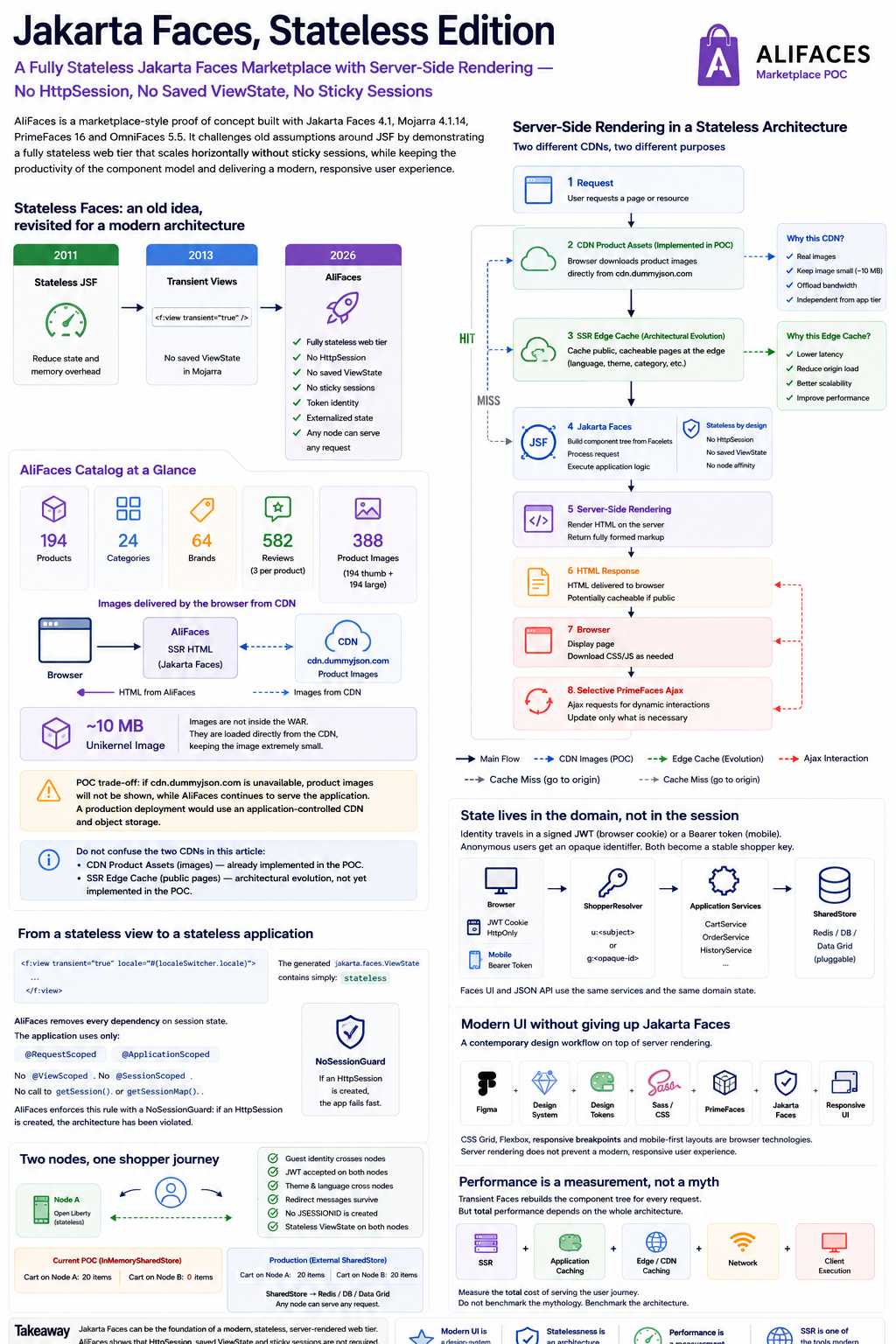
Stateless Faces: an old idea, revisited
Stateless JSF is not new. It was already being explored in 2011 to reduce state and memory overhead, and by 2013 Mojarra supported transient views with:
<f:view transient="true">AliFaces asks a broader question: can an entire modern Jakarta Faces application be designed so that the web tier does not depend on HttpSession, saved ViewState or node affinity?
Every AliFaces page uses a transient master view. The generated jakarta.faces.ViewState is simply stateless. The application uses @RequestScoped and @ApplicationScoped beans, with no @ViewScoped, no @SessionScoped and no application calls to getSession().
A NoSessionGuard turns accidental HttpSession creation into an architectural violation. Statelessness is therefore enforced, not assumed.
A marketplace, not a Hello World
The catalog contains 194 products across 24 categories and 64 brands, with 582 reviews — three per product. Each product carries around 25 fields covering pricing, stock, dimensions, shipping, warranty, returns, tags and reviews.
All 194 thumbnails and 194 full-size images are loaded by the browser directly from cdn.dummyjson.com. They are not packaged inside the WAR, helping keep the complete unikernel image at around 10 MB despite the visually rich catalog.
The external CDN is a deliberate POC trade-off: if it is unavailable, product images disappear while AliFaces continues serving the application. A production deployment would use an application-controlled object store and CDN.
This is separate from edge caching of public SSR pages: product assets are already CDN-delivered in the POC; caching public server-rendered catalog pages at the edge is an architectural evolution.
State lives in the domain, not in the session
A marketplace still needs state. AliFaces removes it from the web node instead of pretending it does not exist.
Browser identity travels in a signed JWT stored in an HttpOnly cookie; mobile clients use a Bearer token; anonymous visitors receive an opaque identifier. ShopperResolver converts these identities into a stable shopper key.
Faces UI and JSON API use the same application services. Cart and history sit behind SharedStore rather than HttpSession. The POC currently uses InMemorySharedStore; a production adapter can use Redis, a database or a data grid without changing Faces pages or application services.
Server-Side Rendering fits naturally
AliFaces deliberately keeps Jakarta Faces’ native Server-Side Rendering model.
This is not a return to an obsolete architecture. Large e-commerce experiences such as Amazon and AliExpress use server-generated and cacheable content within broader hybrid delivery strategies, while JavaScript ecosystems that grew around Client-Side Rendering have also introduced or expanded SSR through Next.js, Nuxt, Angular SSR and SvelteKit.
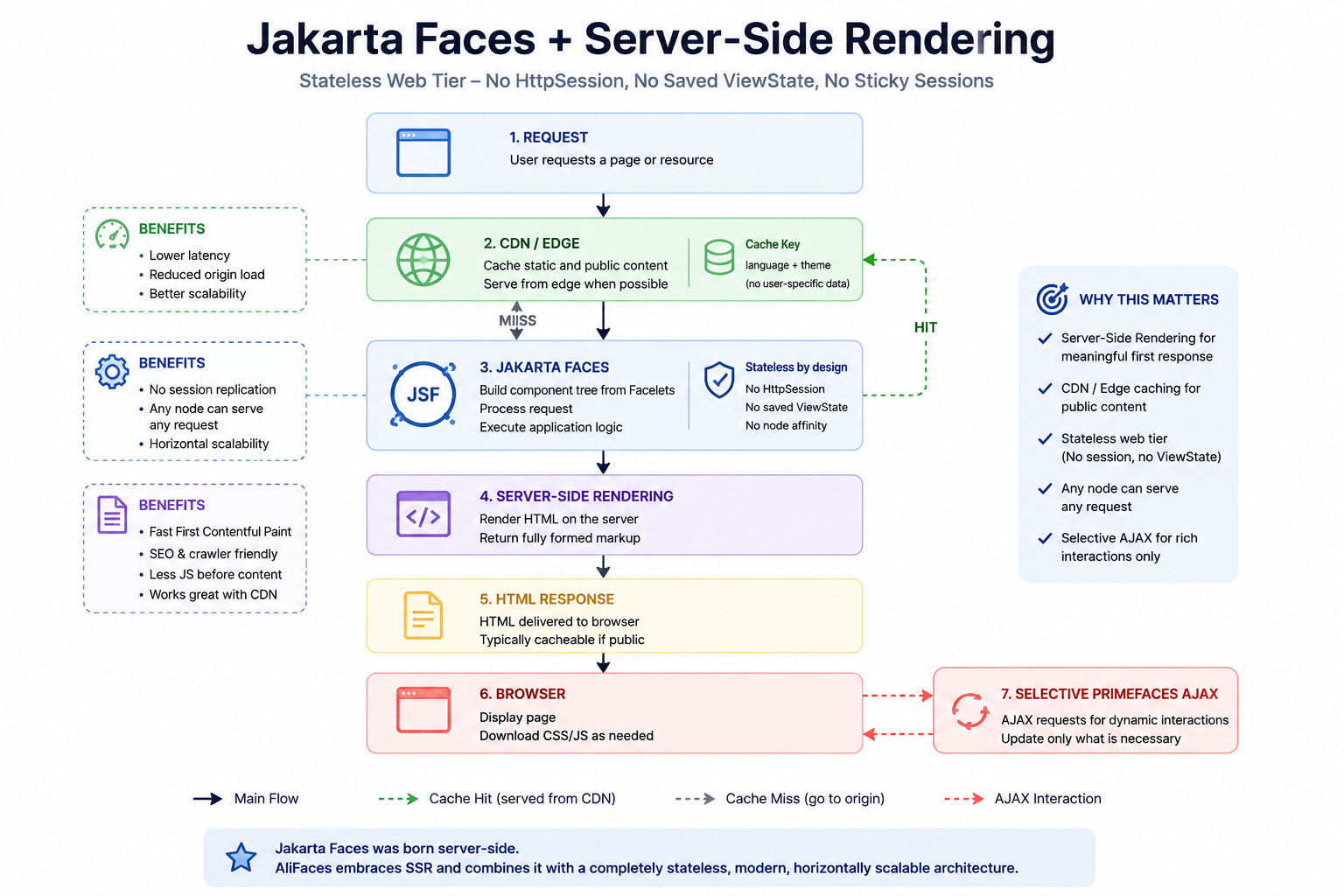
SSR remains useful for meaningful initial HTML, public content, SEO, reduced mandatory client-side work and caching. Jakarta Faces already starts from the server-rendered side; AliFaces combines it with stateless web nodes, CDN-delivered assets, potential edge caching and selective PrimeFaces Ajax.
Server-Side Rendering is not the opposite of a modern frontend. It is one of the tools modern frontends use.
Modern UI is independent of the rendering model
AliFaces follows a contemporary workflow:
Figma → Design System → Design Tokens → Sass / CSS → PrimeFaces → Jakarta Faces → Responsive UI
CSS Grid, Flexbox, responsive breakpoints and mobile-first layouts are browser technologies. Server rendering does not prevent a modern marketplace interface.
Modern UI is a design-system property.
Statelessness is an architecture property.
Performance is a measurement.
Performance is a measurement
Transient Faces rebuilds the component tree for every request. That has a cost, but a cost is not a benchmark result.
A stateless architecture also makes application caching, public edge caching and horizontal scaling easier to reason about. The relevant question is the total cost of serving the user journey across SSR, caching, network and client execution.
Do not benchmark the mythology. Benchmark the architecture.
Two nodes, one shopper
The strongest evidence comes from a two-node test using two independent Open Liberty instances running the same WAR. One logical shopper journey is deliberately alternated between them.
Guest identity crosses nodes. A token created on Node A is accepted by Node B. Theme, language and redirect messages survive node changes. No JSESSIONID is created and both nodes return stateless ViewState.
One boundary is intentionally visible: with InMemorySharedStore, the cart can contain 20 items on Node A and 0 on Node B. This proves the JVMs really have separate memory and identifies exactly where node-local state remains.
Replace that adapter with Redis, a database or a data grid and both nodes use shared, persistent and atomic state. Faces pages and application services do not change.
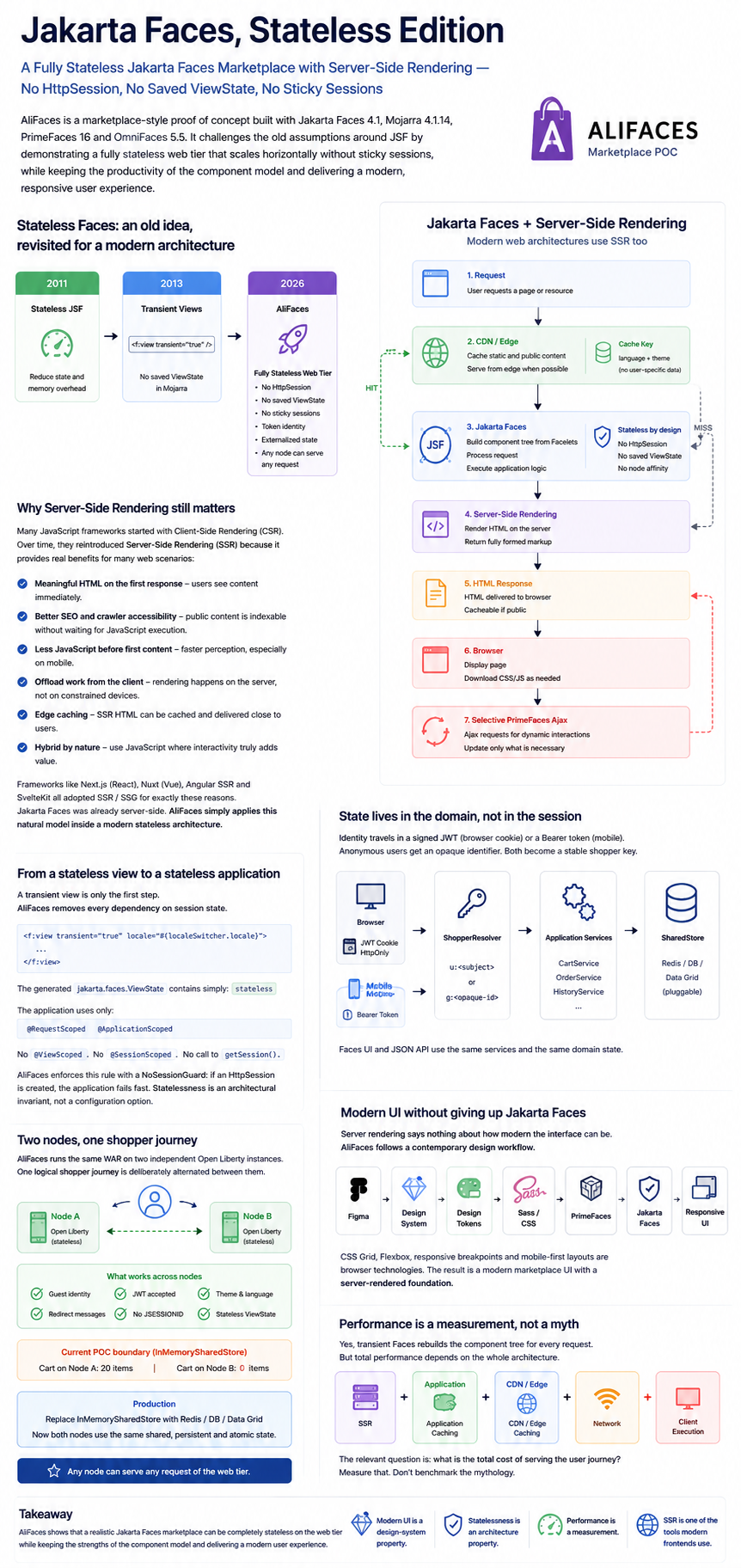
Takeaway
AliFaces is not about proving that one JSF page can be stateless. It asks whether a realistic Jakarta Faces web application can make the entire web tier stateless while retaining native SSR, a modern responsive UI and horizontal scalability.
No HttpSession. No saved ViewState. No sticky sessions. Token identity. Externalized domain state. CDN-delivered assets. Shared application services. Browser and mobile clients. Any web node can serve any request.
Modern UI is a design-system property.
Statelessness is an architecture property.
Performance is a measurement.
Server-Side Rendering is one of the tools modern frontends use.
Jakarta Faces, Stateless Edition.
AliFaces is an independent technical proof of concept. Its marketplace interaction model is used only to exercise realistic e-commerce scenarios. AliFaces and AmaFaces are independent demo brands and are not affiliated with Amazon, AliExpress or any other marketplace company.
References
- Source POC: https://github.com/AngeloRubens/alifaces
- BalusC — Stateless JSF (2013): https://balusc.omnifaces.org/2013/02/
- AWS Compute Blog — Server-side rendering micro-frontends – the architecture: https://aws.amazon.com/blogs/compute/server-side-rendering-micro-frontends-the-architecture/
The post Jakarta Faces, Java Web Framework, Stateless Edition: Marketplace AliFaces appeared first on foojay.